
Calling a report “AI-generated” can poison the well when the label primes an audience to dismiss it before examining its claims. It can also identify a relevant concern about authorship, evidence, or an agreed rule. The difference is what has been established and what the criticism asks us to do next.
Three questions need separate answers: Who produced this work? Is its claim supported? Does its production comply with the relevant policy? Evidence for one answer does not automatically settle the other two.
The following case, people, report, quotations, and alternative outcomes are fictional. They are an original teaching example, not an account of misconduct by a real person.
The Report Nobody Has Read
A college library committee is considering a trial of later Tuesday opening hours. Rae has prepared a report recommending the trial. It includes a student survey, the questions asked, anonymised responses, existing attendance records, and a proposed way to evaluate the trial.
Before Rae presents it, another member says:
“Those headings and that polished introduction are obviously AI-generated. Don’t waste time reading the report; Rae’s recommendations are just chatbot output.”
The committee has not yet checked the survey, the attendance records, or the proposed evaluation. The remark moves from a suspicion about writing style to a verdict on the whole contribution.
The classic poisoning-the-well pattern is the advance invitation to dismiss. Douglas Walton’s analysis of poisoning the well also explains the broader problem of attacks that obstruct someone’s ability to contribute to a discussion. Applying that account here is our interpretation of the fictional exchange, not a claim that Walton’s 2006 paper discussed generative AI.
Keep the Claim Fixed; Change the Evidence
The report’s recommendation stays the same in these three alternative versions. What changes is the evidence available to the committee.
| Version | What is established? | What follows? |
|---|---|---|
| Unsupported suspicion | A reader thinks the style looks machine-written. There is no disclosure or other evidence of AI use. | Authorship is unresolved. Ask a specific question about how the report was produced; inspect the survey and records. |
| Disclosed assistance | Rae used an AI tool to reorganise paragraphs and discloses this. The committee permits that use. The original survey and attendance records are available. | Check the evidence and reasoning. Permitted assistance does not establish accuracy, but it does not refute the recommendation either. |
| Demonstrated fabrication | Rae acknowledges that a cited study is fictitious: a tool invented the reference, and no real study underlies it. | Remove the unsupported citation and reconsider the claim that relied on it. Audit other references; do not assume that the separate attendance records must also be false. |
In the third version, the criticism is substantial. The committee has identified a failure in the evidence, not merely an unfavourable label. That finding could justify withholding a decision until the report is corrected. It still does not establish whether a carefully evaluated opening-hours trial would succeed.
Failing to find a citation in one search is not the same as demonstrating fabrication. A reference can be incomplete, misspelled, or difficult to access. In this fictional version, the author acknowledges an invented reference with no real study behind it; it is not merely a source the committee has trouble finding.
Name the Reasoning Problem Precisely
| Statement | Assessment in context |
|---|---|
| “Before Rae speaks, ignore the report: it is AI-generated.” | Poisoning the well when it pre-discredits the contribution without examining the relevant evidence. |
| “AI helped write it, therefore its conclusion is false.” | A genetic-fallacy inference when origin alone is treated as a verdict on truth. It can also poison the well if used to prime an audience. |
| “This reference is fabricated, so it cannot support this claim.” | A direct evidential objection when the fabrication has been established. |
| “This assignment requires independent composition; we need to establish how it was written.” | A relevant authorship inquiry. Compliance is a separate issue from whether the text contains true statements. |
The genetic-fallacy comparison explains why provenance can matter without deciding every claim. The ad hominem comparison explains why a personal or source-related warning is not automatically fallacious.
An AI-generated “eyewitness account,” for example, cannot establish firsthand observation merely because it sounds plausible. Authorship bears directly on the claimed route to knowledge. Likewise, an institution may reasonably assess whether an author followed a stated disclosure or independent-work requirement. Calling the inquiry a fallacy does not answer it.
What a Detector Can and Cannot Establish
In their 2023 study of GPT detectors, Weixin Liang and colleagues found that the detectors they evaluated frequently misclassified non-native English writing as AI-generated. That is evidence about the systems and writing samples studied in 2023. It is not an error-rate estimate for every detector available today, nor proof that any particular current accusation is mistaken.
Turnitin’s guidance on its AI Writing Report, checked on 14 September 2026, acknowledges possible misclassification and says the report should not be the only basis for action against a student. It calls for further scrutiny, human judgement, and consideration of the institution’s policies. The displayed percentage concerns qualifying text the model identifies as likely AI-generated; it is not a probability that the author committed misconduct.
For the library report, a detector result would be another item to interpret, not a test of the attendance records or an answer to the opening-hours proposal. Ask what the tool measures, what text it evaluated, and what other evidence supports the concern. Avoid turning uncertainty into a confident public accusation.
A Fair-Criticism Checklist
- Identify the claim. Write down the particular proposition or recommendation being assessed. Separate the report’s survey result from its proposed action.
- Establish what is known about provenance. Distinguish a stylistic impression, a detector signal, a disclosure, and documented evidence. Record what remains uncertain.
- Inspect the support. Open the cited source, check that it supports the statement, inspect the data where available, and reproduce the relevant calculation.
- Explain why authorship matters here. Is the issue firsthand knowledge, independent composition, disclosure, authenticity, or factual support? Name the connection.
- Propose a proportionate check. Ask for clarification, source verification, a correction, or review under the applicable policy. State what evidence would resolve the concern.
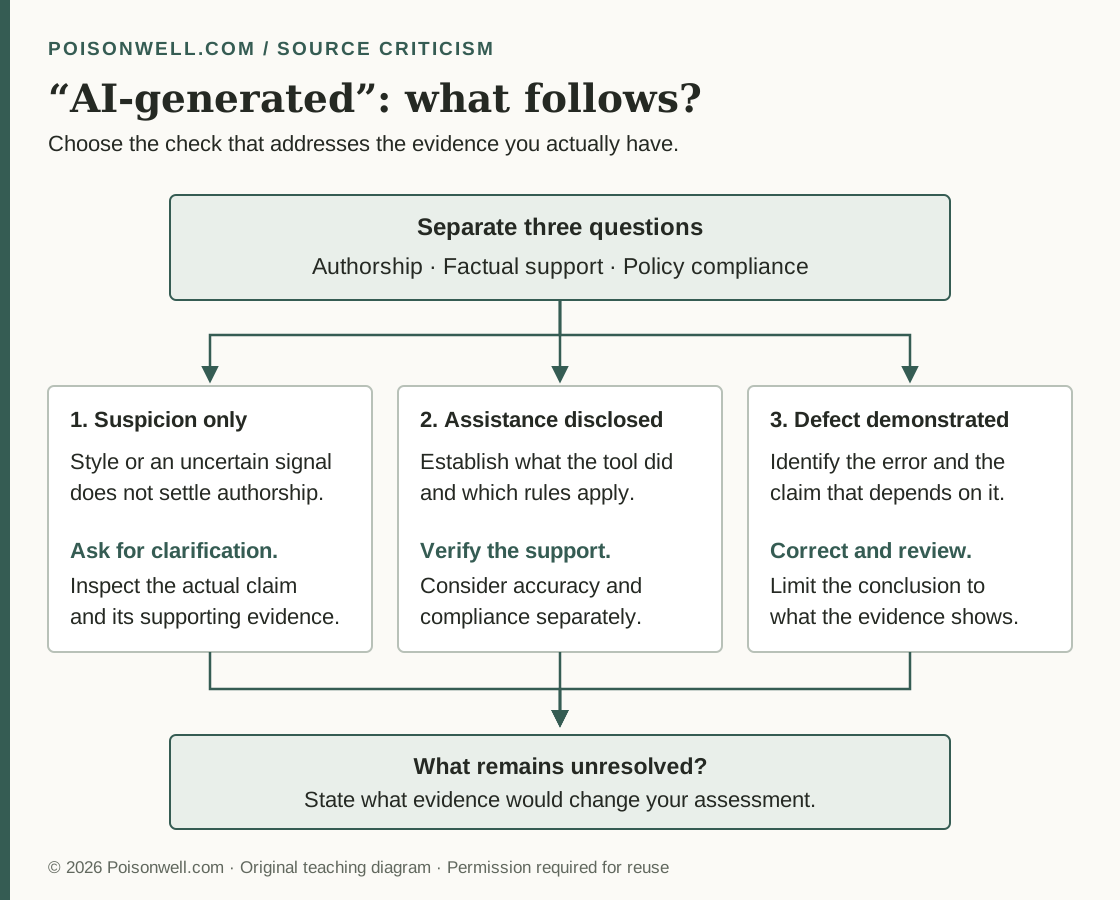
Start with what is established, then choose the check that addresses it. The three paths are explained in the text below.
Creator and credit: Poisonwell.com. © 2026 Poisonwell.com. All rights reserved; permission required. Request permission to reuse the diagram.
Read the diagram: Begin by separating the authorship question from the evidence and policy questions. If there is only suspicion, keep authorship unresolved and seek clarification. If assistance is disclosed, establish what the tool did, check the evidence, and assess any relevant rule. If a defect is demonstrated, correct the affected claim and review related support. In every path, state what remains unsettled and what could change the assessment.
A Better Committee Exchange
Chair: “We have a concern about how the report was produced. Rae, explain any tools you used and point us to the survey and attendance records. Then we will evaluate the recommendation against those materials.”
Rae: “I used a tool to reorganise my draft and disclosed that on the first page. Here are the original questions, responses, and attendance records. Which finding should we check first?”
That answer offers a route to verification. It does not demand trust, establish that the report is correct, or prevent the committee from challenging the evidence.
If an objection identifies a genuine fabricated reference, a better response is: “That reference should not have been included. I will remove it, correct the claim it supported, and check the remaining citations.” Naming poisoning the well would not repair the error.
For a broader method, use the six-question source test. For a short spoken reply, see how to respond to poisoning the well. Teachers can use the matched versions with the classroom discussion prompt.
Sources and Editorial Scope
- Douglas N. Walton, “Poisoning the Well,” Argumentation 20 (2006), 273–307. Used for the discussion-silencing account, not for claims about AI tools.
- Weixin Liang, Mert Yuksekgonul, Yining Mao, Eric Wu, and James Zou, “GPT detectors are biased against non-native English writers” (2023), version 3. Used for the historical detector study, within its tested scope.
- Turnitin, “Using the AI Writing Report”, accessed 14 September 2026. Used for the provider’s stated report interpretation and limitations.
The fictional case, matched comparisons, checklist, and diagram are Poisonwell.com’s editorial analysis. A site or classroom can require human authorship or particular disclosures; this article does not decide whether an individual submission complies with such a requirement. See our editorial policy for sourcing, AI assistance, and corrections.