
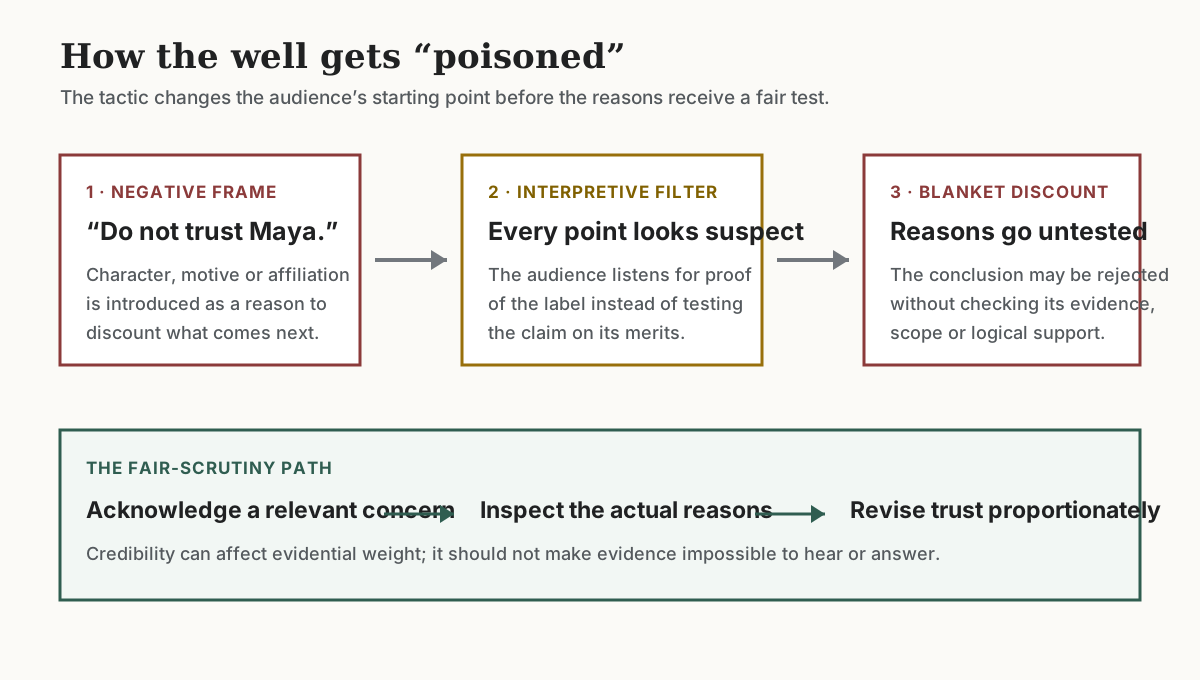
To poison the well means to make an audience distrust a person or source before considering their argument, using negative framing in place of a fair hearing.[1]
Fictional example: before Lee proposes a change, a colleague says, “You know what Lee is like—Lee always wants attention.” The audience is invited to dismiss Lee before hearing the proposal.
Closely matched fair criticism: “Lee's proposal assumes a two-week delivery. Ask for the task estimates before approving it.” This identifies something the group can check.
On this page
Why the Example Qualifies#
The problem with the remark about Lee is its role in the decision: it supplies a broad motive before the proposal is heard, without identifying a defect in the proposal.
Lee might want attention, and the proposal might still be sound or unsound. Neither the motive allegation nor identifying the fallacy settles the merits. The task estimates give the group a way to investigate.
The Three Features to Look For#
All three features make the diagnosis stronger. An insult alone is not necessarily poisoning the well; a criticism after full examination may be another kind of ad hominem or may be relevant.
| Feature | Question | Why it matters |
|---|---|---|
| Pre-framing | Does adverse framing arrive before or at the threshold of the contribution? | It changes the audience's starting point. |
| Broad disqualification | Does the framing cover whatever the target might say? | A specific reliability concern has become a general veto. |
| Substitution | Does the audience still examine the claim, method, or evidence? | If not, source judgement has replaced argument evaluation. |
Logical Pattern#
Walton's formulation is deliberately broad: a source may be said not to be in a position to know because of experience, bias, or character, and therefore everything the source says on the issue is treated as discardable.[2]
- Negative claim: source S has a bad trait, motive, affiliation, history, or social position.
- Disqualifying inference: therefore contributions from S on issue I need not be heard or evaluated.
- Dismissal: claim C is rejected, or its evidential force is reduced to zero, without an adequate connection between the negative fact and C.
It Is Not Just an Insult#
“That was rude” and “that poisoned the well” are different judgements. The first concerns tone or treatment. The second concerns the role a remark plays in reasoning and discussion.
A civil sentence can poison the well: “As a responsible moderator, I should tell you that our next witness comes from an advocacy organisation.” If the disclosure silently instructs the audience to disregard all testimony, polite phrasing does not cure the problem.
Conversely, a sharp criticism can be relevant: “The witness claims direct knowledge, but the timestamp proves the witness was not present.” That challenges a stated basis for testimony.
The Boundary: Credibility Versus Dismissal#
Credibility is sometimes evidence. Expertise, access, conflicts of interest, a record of fabrication, and methods of verification can affect how testimony should be weighted. Informal logic therefore does not require pretending that every source is equally reliable.[4]
The relevant boundary is whether a source fact is accurate, connected to this kind of claim, given proportionate weight, and followed by a way to check the claim. A broad background fact alone should not disqualify a person from participation.[3]
The right column retains any relevant credibility concern and connects it to a checkable question.
| Setting | Poisoned-well wording | Fairer wording |
|---|---|---|
| Workplace | Before Alex reports the problem, remember that Alex always expects the worst. | Alex has raised several risks; ask for reproduction steps, user impact, and the cost of each remedy. |
| Public policy | Anyone questioning this proposal is against safer streets. | Critics should explain which safety outcome they dispute and compare the available evidence. |
| Research | The authors received industry funding, so the study is worthless. | The funding is relevant; inspect the protocol, disclosure, data, and independent replication. |
| Family | Before Sam explains, remember that Sam always makes everything dramatic. | Hear the present concern first, then decide whether the earlier pattern is relevant. |
A full guide to source criticism
Apply a six-question test to expertise, incentives, track records, affiliations, and firsthand access.
Read the source-criticism guide
A Broader Scholarly Use#
The familiar textbook definition focuses on timing: discrediting someone before testimony or argument is given.[1]
Walton focuses on what the move does within a dialogue. It can improperly shut down an opponent's capacity to advance the kinds of arguments a discussion requires. That explains why some cases concern a participant's right to be heard, not only whether one proposition is true.[2]
How the Phrase Is Used#
| Form | Example |
|---|---|
| Poison the well | The introduction may poison the well before the panel hears the evidence. |
| Poisoning the well | Calling every future critic corrupt is poisoning the well. |
| Poisoned-well argument | The moderator rejected the poisoned-well argument and asked for a direct objection. |
| The well was poisoned | By the time the witness spoke, the well had already been poisoned. |
Frequently asked questions#
What does poisoning the well mean?
Poisoning the well means preemptively framing a person, group, or source as unworthy of a fair hearing, so that an audience discounts what they later say without first examining the reasons or evidence.
What is the shortest example?
"Before you hear Mara's proposal, remember that she always has an agenda." The remark gives the audience a reason to distrust Mara before the proposal is heard.
Is poisoning the well a formal fallacy?
No. It is normally treated as an informal fallacy because whether the move is defective depends on relevance, context, and how the credibility information is used—not only on logical form.
Must the attack come before the argument?
Preemption is the classic pattern: the audience is primed before the target can speak. Some scholarship uses the label more broadly for a move that attempts to disqualify a participant's present or future contributions and shut down discussion.
Can the target be an organization or publication?
Yes. A newspaper, university, company, political group, or research field can be dismissed in advance just as an individual can. The important question is whether the source label replaces examination of the particular claim.
Is mentioning bias always poisoning the well?
No. Bias can affect what a source notices, measures, or reports. A fair criticism identifies the relevant mechanism and calls for an appropriate check; a poisoned-well move treats a broad allegation of bias as permission to ignore the claim.[4]
Can true information be used to poison the well?
Yes. A true detail can be irrelevant, exaggerated, or made to bear more weight than it can support. Truth is necessary for responsible source criticism, but truth alone does not establish relevance or justify blanket dismissal.[3]
Companion video channel
Further watching on Slopernet
For readers who prefer spoken analysis, Slopernet is the companion channel for longer discussions of phrases, rhetoric, and etymology.
References#
Bradley Dowden. Internet Encyclopedia of Philosophy. Internet Encyclopedia of Philosophy. Entries on Ad Hominem, Poisoning the Well, Straw Man, Red Herring, and related fallacies.
Peer-reviewed reference used for concise fallacy definitions and for the common classification of poisoning the well as preemptive circumstantial ad hominem.
Douglas N. Walton. Argumentation. Argumentation, volume 20, issue 3, pages 273–307. 2006. pp. 273–307.
Peer-reviewed analysis of poisoning the well as a strategic personal attack that can prevent an opponent from contributing arguments to a critical discussion.
Hendrik Kotzee. Argumentation. Argumentation, volume 24, issue 3, pages 265–281. 2010. pp. 265–281.
Peer-reviewed discussion of when a participant's background can be relevant and why broad identity facts alone do not legitimately disqualify participation.
Leo Groarke. The Stanford Encyclopedia of Philosophy. Metaphysics Research Lab, Stanford University. 2026. Sections on informal argument evaluation and ad hominem.
Scholarly overview used for the broader context of evaluating ordinary-language arguments and for the point that source criticism can sometimes be relevant rather than automatically fallacious.
Revision history
- : Reworked the opening into a definition and matched example; retained the recognition test, usage, and credibility boundaries. — reviewed by Poisonwell Editorial Team
- : Added a direct meaning-and-example passage for faster recognition without changing the page's scope. — reviewed by Poisonwell Editorial Team
- : Definition tightened and expanded with formal structure, usage notes, and source-criticism boundaries. — reviewed by Poisonwell Editorial Team